

Barcode Scanner Market Size to Hit USD 13.0 Billion, Globally, by 2033 at 6.13% CAGR
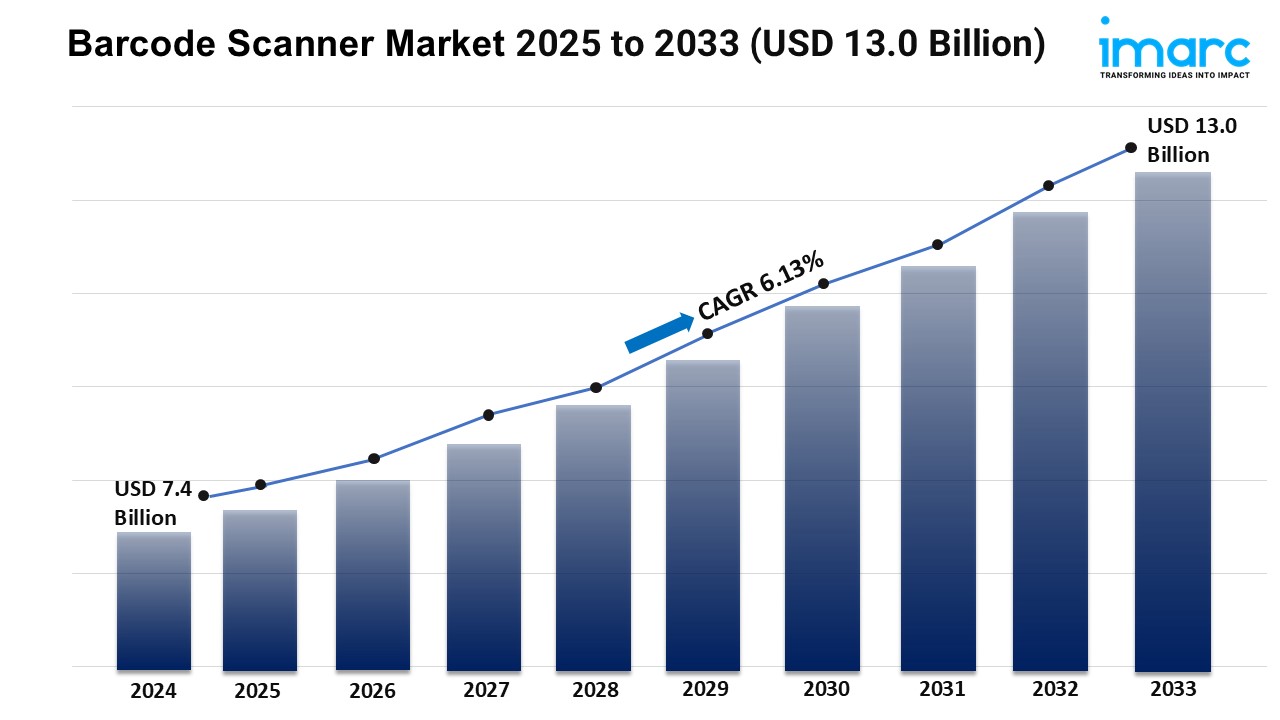
Barcode Scanner Market Growth
IMARC Group expects the market to reach USD 13.0 Billion by 2033, exhibiting a growth rate (CAGR) of 6.13% during 2025-2033.
SHERDIAN, WY, UNITED STATES, July 11, 2025 /EINPresswire.com/ -- 𝐌𝐚𝐫𝐤𝐞𝐭 𝐎𝐯𝐞𝐫𝐯𝐢𝐞𝐰:The barcode scanner market is experiencing rapid growth, driven by rising demand for automation in retail and inventory management, expansion of e-commerce and logistics sectors, and technological advancements in scanning solutions. According to IMARC Group's latest research publication, "𝐁𝐚𝐫𝐜𝐨𝐝𝐞 𝐒𝐜𝐚𝐧𝐧𝐞𝐫 𝐌𝐚𝐫𝐤𝐞𝐭: 𝐆𝐥𝐨𝐛𝐚𝐥 𝐈𝐧𝐝𝐮𝐬𝐭𝐫𝐲 𝐓𝐫𝐞𝐧𝐝𝐬, 𝐒𝐡𝐚𝐫𝐞, 𝐒𝐢𝐳𝐞, 𝐆𝐫𝐨𝐰𝐭𝐡, 𝐎𝐩𝐩𝐨𝐫𝐭𝐮𝐧𝐢𝐭𝐲 𝐚𝐧𝐝 𝐅𝐨𝐫𝐞𝐜𝐚𝐬𝐭 𝟐𝟎𝟐𝟓-𝟐𝟎𝟑𝟑",The global barcode scanner market size reached 𝐔𝐒𝐃 𝟕.𝟒 𝐁𝐢𝐥𝐥𝐢𝐨𝐧 in 2024. Looking forward, IMARC Group expects the market to reach 𝐔𝐒𝐃 𝟏𝟑.𝟎 𝐁𝐢𝐥𝐥𝐢𝐨𝐧 by 2033, exhibiting a growth rate (𝐂𝐀𝐆𝐑) 𝐨𝐟 𝟔.𝟏𝟑% during 2025-2033.
This detailed analysis primarily encompasses industry size, business trends, market share, key growth factors, and regional forecasts. The report offers a comprehensive overview and integrates research findings, market assessments, and data from different sources. It also includes pivotal market dynamics like drivers and challenges, while also highlighting growth opportunities, financial insights, technological improvements, emerging trends, and innovations. Besides this, the report provides regional market evaluation, along with a competitive landscape analysis.
𝐆𝐫𝐚𝐛 𝐚 𝐬𝐚𝐦𝐩𝐥𝐞 𝐏𝐃𝐅 𝐨𝐟 𝐭𝐡𝐢𝐬 𝐫𝐞𝐩𝐨𝐫𝐭: https://www.imarcgroup.com/barcode-scanner-market/requestsample
𝐎𝐮𝐫 𝐫𝐞𝐩𝐨𝐫𝐭 𝐢𝐧𝐜𝐥𝐮𝐝𝐞𝐬:
● Market Dynamics
● Market Trends And Market Outlook
● Competitive Analysis
● Industry Segmentation
● Strategic Recommendations
𝐆𝐫𝐨𝐰𝐭𝐡 𝐅𝐚𝐜𝐭𝐨𝐫𝐬 𝐢𝐧 𝐭𝐡𝐞 𝐁𝐚𝐫𝐜𝐨𝐝𝐞 𝐒𝐜𝐚𝐧𝐧𝐞𝐫 𝐌𝐚𝐫𝐤𝐞𝐭
● 𝐑𝐢𝐬𝐢𝐧𝐠 𝐃𝐞𝐦𝐚𝐧𝐝 𝐟𝐨𝐫 𝐀𝐮𝐭𝐨𝐦𝐚𝐭𝐢𝐨𝐧 𝐢𝐧 𝐑𝐞𝐭𝐚𝐢𝐥 𝐚𝐧𝐝 𝐈𝐧𝐯𝐞𝐧𝐭𝐨𝐫𝐲 𝐌𝐚𝐧𝐚𝐠𝐞𝐦𝐞𝐧𝐭:
Growth in the barcode scanner market is booming as the demand for automation in both retail and warehouse spaces increases. In particular, retailers and warehouses are implementing barcode scanners in their processes, thereby increasing the speed and overall efficiency of their businesses while reducing human error. For example, grocery store chain Walmart uses barcode scanners to track inventory in their stores so that shelves are stocked for shoppers; therefore losing out on overstocked items or risks of losing items from stockouts. Overall, barcode scanners speed the data capture process, allowing retailers to improve customer satisfaction and get transactions out the door more quickly. Due to the continued rise of e-commerce, the need for an efficient inventory tracking system has led to an increased demand for advanced barcode scanners in all areas of industry.
● 𝐄𝐱𝐩𝐚𝐧𝐬𝐢𝐨𝐧 𝐨𝐟 𝐄-𝐜𝐨𝐦𝐦𝐞𝐫𝐜𝐞 𝐚𝐧𝐝 𝐋𝐨𝐠𝐢𝐬𝐭𝐢𝐜𝐬 𝐒𝐞𝐜𝐭𝐨𝐫𝐬:
The growth of e-commerce and the logistics sector has significantly influenced the demand for barcode scanners. The massive volume of packages handled by logistics companies (especially with e-commerce companies–like Amazon–on the rise) requires powerful systems for managing that volume of goods. Barcode scanners have gotten better, and they help keep on top of accurate tracking and sorting of goods, both in the warehouse and while goods are in transit. For example, a company like DHL uses a barcode system that helps keep packages moving swiftly through their system, while eliminating delivery errors. As the global trade continues to rise, especially given consumers' want for faster order fulfillment and better supply chain computerization, companies are investing in better performing high-tech scanners; including mobile, and wireless scanners to manage those complex environments.
● 𝐓𝐞𝐜𝐡𝐧𝐨𝐥𝐨𝐠𝐢𝐜𝐚𝐥 𝐀𝐝𝐯𝐚𝐧𝐜𝐞𝐦𝐞𝐧𝐭𝐬 𝐢𝐧 𝐒𝐜𝐚𝐧𝐧𝐢𝐧𝐠 𝐒𝐨𝐥𝐮𝐭𝐢𝐨𝐧𝐬:
Advancements in technology are pushing the barcode scanner market to new heights by providing devices that allow for higher efficiencies and flexibility. Newer scanners on the market provide a wide range of 2D barcodes (for example, QR codes) which can contain more data than the traditional 1D barcode. Companies, such as Zebra Technologies, have created scanners, with improved imaging capabilities enabling them to read damaged or subpar barcodes. Scanners existed in conjunction with mobile devices and cloud systems can also support and improve data access. For instance, healthcare facilities have worked to create state-of-the-art scanners that monitor patient records and medications accurately resulting in safer interactions with patients. As technology advances, barcode scanners have proven to have viability in an array of industries.
𝐊𝐞𝐲 𝐓𝐫𝐞𝐧𝐝𝐬 𝐢𝐧 𝐭𝐡𝐞 𝐁𝐚𝐫𝐜𝐨𝐝𝐞 𝐒𝐜𝐚𝐧𝐧𝐞𝐫 𝐌𝐚𝐫𝐤𝐞𝐭
● 𝐒𝐡𝐢𝐟𝐭 𝐓𝐨𝐰𝐚𝐫𝐝 𝟐𝐃 𝐁𝐚𝐫𝐜𝐨𝐝𝐞 𝐒𝐜𝐚𝐧𝐧𝐞𝐫𝐬:
A key trend in the barcode scanner industry is the transition from 1D to 2D barcode scanners. Whereas 1D barcodes contain limited information, 2D barcodes (QR codes, for example) can hold a significant amount of data (URL's, product details), and provide a wide variety of applications in retail and marketing situations. One example of this is the use of QR codes by restaurants customers can access digital menus using through the QR code on restaurant menus in order to place their orders directly. The market trend is simply a reaction to the growing need for more data and solutions that improve the customer experience (engagement) or the experience of workflow (processes). Moving forward, manufacturers will seek to improve 2D scanners with advanced imaging technology to meet the move to more advanced consumer engagement and improvements in efficiency.
● 𝐈𝐧𝐭𝐞𝐠𝐫𝐚𝐭𝐢𝐨𝐧 𝐰𝐢𝐭𝐡 𝐌𝐨𝐛𝐢𝐥𝐞 𝐚𝐧𝐝 𝐖𝐢𝐫𝐞𝐥𝐞𝐬𝐬 𝐓𝐞𝐜𝐡𝐧𝐨𝐥𝐨𝐠𝐢𝐞𝐬:
Mobile and wireless technology is changing the landscape of the market, as many new scanners are being designed to be compatible with mobile devices like smartphones and tablets, as well as cloud-based solutions effectively enabling real-time reporting and sharing of data. An example of this is the wireless barcode scanners currently being used by FedEx as a means to instantly report status changes of packages while they are in motion, which allows for greater visibility in the logistics operation. This development can help organizations work more flexibly and freely, because employees are always prone to carry portable devices they can maneuver in times of new environments (such as warehouses or retail floors). Additionally, Bluetooth barcode scanners and mobile apps have made the option for lower-cost scanning more cost-effective for small businesses - geography is less of a limitation in terms of where they're selling or service their material.
● 𝐆𝐫𝐨𝐰𝐢𝐧𝐠 𝐀𝐝𝐨𝐩𝐭𝐢𝐨𝐧 𝐢𝐧 𝐍𝐨𝐧-𝐓𝐫𝐚𝐝𝐢𝐭𝐢𝐨𝐧𝐚𝐥 𝐒𝐞𝐜𝐭𝐨𝐫𝐬:
Barcode scanners are being more and more used in areas outside of retail, such as healthcare (tracking medical equipment as well as patients' wristbands to eliminate mistakes in administering care), hospitality (using scans to record check-ins and manage supplies), and education (to track attendance). Mayo Clinic has also engaged a barcode system to ensure medication prescribed to patients is managed and administered accurately. This shows just how much barcode technology can improve operations with all the flexibility to adapt it for many industries. As these industries have become aware of accurate data tracking in the manager's data set, the interest in specialized barcode scanners for their specific environments will only continue.
𝐁𝐮𝐲 𝐅𝐮𝐥𝐥 𝐑𝐞𝐩𝐨𝐫𝐭: https://www.imarcgroup.com/checkout?id=2159&method=1670
𝐋𝐞𝐚𝐝𝐢𝐧𝐠 𝐂𝐨𝐦𝐩𝐚𝐧𝐢𝐞𝐬 𝐎𝐩𝐞𝐫𝐚𝐭𝐢𝐧𝐠 𝐢𝐧 𝐭𝐡𝐞 𝐆𝐥𝐨𝐛𝐚𝐥 𝐁𝐚𝐫𝐜𝐨𝐝𝐞 𝐒𝐜𝐚𝐧𝐧𝐞𝐫 𝐈𝐧𝐝𝐮𝐬𝐭𝐫𝐲:
● Bluebird Inc.
● Cognex Corporation
● Datalogic S.p.A. (Hydra S.p.A)
● Denso Wave Incorporated
● Honeywell International Inc.
● JC Square Inc. (GMO Hosting & Security Inc.)
● SATO Holdings Corporation
● Scandit AG
● Toshiba TEC Corporation
● Zebra Technologies Corporation
𝐁𝐚𝐫𝐜𝐨𝐝𝐞 𝐒𝐜𝐚𝐧𝐧𝐞𝐫 𝐌𝐚𝐫𝐤𝐞𝐭 𝐑𝐞𝐩𝐨𝐫𝐭 𝐒𝐞𝐠𝐦𝐞𝐧𝐭𝐚𝐭𝐢𝐨𝐧:
𝐁𝐲 𝐏𝐫𝐨𝐝𝐮𝐜𝐭:
● Handheld Barcode Scanner
● Stationary Barcode Scanner
Handheld barcode scanner exhibits a clear dominance in the market due to their convenience, portability, and ease of use in diverse settings.
𝐁𝐲 𝐓𝐲𝐩𝐞:
● Wired Barcode Scanner
● Wireless Barcode Scanner
Based on the type, the market has been bifurcated into wired barcode scanner and wireless barcode scanner.
𝐁𝐲 𝐒𝐜𝐚𝐧𝐧𝐞𝐫 𝐓𝐲𝐩𝐞:
● Rugged Barcode Scanner
● Non-Rugged Barcode Scanner
On the basis of the scanner type, the market has been classified into rugged barcode scanner and non-rugged barcode scanner.
𝐁𝐲 𝐓𝐞𝐜𝐡𝐧𝐨𝐥𝐨𝐠𝐲:
● Camera Based Reader
● Charge Coupled Device Reader
● Laser Scanner
● Omni Directional Barcode Scanners
● Pen Type Reader
● RFID Reader
● Smart Phone Based Scanner
● Others
Charge coupled device reader represents the largest segment attributed to their accuracy, lower cost, and ability to read barcodes from a shorter distance.
𝐁𝐲 𝐂𝐨𝐦𝐩𝐨𝐧𝐞𝐧𝐭:
● Solutions
● Services
Based on the component, the market has been segregated into solutions and services.
𝐁𝐲 𝐄𝐧𝐝-𝐔𝐬𝐞 𝐒𝐞𝐜𝐭𝐨𝐫:
● Retail and Commercial
● General Manufacturing
● Healthcare
● Logistics and Warehousing
● Commercial Aviation
● Defense
● Others
Logistics and warehousing account for the majority of the market share owing to the critical need for efficient tracking and management of goods in these sectors.
𝐑𝐞𝐠𝐢𝐨𝐧𝐚𝐥 𝐈𝐧𝐬𝐢𝐠𝐡𝐭𝐬:
● North America (United States, Canada)
● Asia Pacific (China, Japan, India, South Korea, Australia, Indonesia, Others)
● Europe (Germany, France, United Kingdom, Italy, Spain, Russia, Others)
● Latin America (Brazil, Mexico, Others)
● Middle East and Africa
Asia Pacific dominates the market, driven by the increasing adoption of advanced tracking technologies in the region.
𝐎𝐭𝐡𝐞𝐫 𝐑𝐞𝐥𝐚𝐭𝐞𝐝 𝐑𝐞𝐩𝐨𝐫𝐭𝐬 𝐛𝐲 𝐈𝐌𝐀𝐑𝐂 𝐆𝐫𝐨𝐮𝐩:
Sports Medicine Market Research Report
Urgent Care Apps Market Research Report
𝐓𝐰𝐨-𝐖𝐡𝐞𝐞𝐥𝐞𝐫 𝐌𝐚𝐫𝐤𝐞𝐭: https://www.imarcgroup.com/two-wheeler-market
𝐒𝐦𝐚𝐫𝐭 𝐂𝐨𝐧𝐧𝐞𝐜𝐭𝐞𝐝 𝐏𝐞𝐭 𝐂𝐨𝐥𝐥𝐚𝐫 𝐌𝐚𝐫𝐤𝐞𝐭: https://www.imarcgroup.com/smart-connected-pet-collar-market
𝐒𝐞𝐥𝐟-𝐒𝐞𝐫𝐯𝐢𝐜𝐞 𝐁𝐢 𝐌𝐚𝐫𝐤𝐞𝐭: https://www.imarcgroup.com/self-service-bi-market
𝐑𝐞𝐬𝐞𝐚𝐫𝐜𝐡 𝐌𝐞𝐭𝐡𝐨𝐝𝐨𝐥𝐨𝐠𝐲:
The report employs a 𝐜𝐨𝐦𝐩𝐫𝐞𝐡𝐞𝐧𝐬𝐢𝐯𝐞 𝐫𝐞𝐬𝐞𝐚𝐫𝐜𝐡 𝐦𝐞𝐭𝐡𝐨𝐝𝐨𝐥𝐨𝐠𝐲, combining 𝐩𝐫𝐢𝐦𝐚𝐫𝐲 𝐚𝐧𝐝 𝐬𝐞𝐜𝐨𝐧𝐝𝐚𝐫𝐲 𝐝𝐚𝐭𝐚 𝐬𝐨𝐮𝐫𝐜𝐞𝐬 to validate findings. It includes 𝐦𝐚𝐫𝐤𝐞𝐭 𝐚𝐬𝐬𝐞𝐬𝐬𝐦𝐞𝐧𝐭𝐬, 𝐬𝐮𝐫𝐯𝐞𝐲𝐬, 𝐞𝐱𝐩𝐞𝐫𝐭 𝐨𝐩𝐢𝐧𝐢𝐨𝐧𝐬, 𝐚𝐧𝐝 𝐝𝐚𝐭𝐚 𝐭𝐫𝐢𝐚𝐧𝐠𝐮𝐥𝐚𝐭𝐢𝐨𝐧 𝐭𝐞𝐜𝐡𝐧𝐢𝐪𝐮𝐞𝐬 to ensure 𝐚𝐜𝐜𝐮𝐫𝐚𝐜𝐲 𝐚𝐧𝐝 𝐫𝐞𝐥𝐢𝐚𝐛𝐢𝐥𝐢𝐭𝐲.
𝐍𝐨𝐭𝐞: 𝐈𝐟 𝐲𝐨𝐮 𝐫𝐞𝐪𝐮𝐢𝐫𝐞 𝐬𝐩𝐞𝐜𝐢𝐟𝐢𝐜 𝐝𝐞𝐭𝐚𝐢𝐥𝐬, 𝐝𝐚𝐭𝐚, 𝐨𝐫 𝐢𝐧𝐬𝐢𝐠𝐡𝐭𝐬 𝐭𝐡𝐚𝐭 𝐚𝐫𝐞 𝐧𝐨𝐭 𝐜𝐮𝐫𝐫𝐞𝐧𝐭𝐥𝐲 𝐢𝐧𝐜𝐥𝐮𝐝𝐞𝐝 𝐢𝐧 𝐭𝐡𝐞 𝐬𝐜𝐨𝐩𝐞 𝐨𝐟 𝐭𝐡𝐢𝐬 𝐫𝐞𝐩𝐨𝐫𝐭, 𝐰𝐞 𝐚𝐫𝐞 𝐡𝐚𝐩𝐩𝐲 𝐭𝐨 𝐚𝐜𝐜𝐨𝐦𝐦𝐨𝐝𝐚𝐭𝐞 𝐲𝐨𝐮𝐫 𝐫𝐞𝐪𝐮𝐞𝐬𝐭. 𝐀𝐬 𝐩𝐚𝐫𝐭 𝐨𝐟 𝐨𝐮𝐫 𝐜𝐮𝐬𝐭𝐨𝐦𝐢𝐳𝐚𝐭𝐢𝐨𝐧 𝐬𝐞𝐫𝐯𝐢𝐜𝐞, 𝐰𝐞 𝐰𝐢𝐥𝐥 𝐠𝐚𝐭𝐡𝐞𝐫 𝐚𝐧𝐝 𝐩𝐫𝐨𝐯𝐢𝐝𝐞 𝐭𝐡𝐞 𝐚𝐝𝐝𝐢𝐭𝐢𝐨𝐧𝐚𝐥 𝐢𝐧𝐟𝐨𝐫𝐦𝐚𝐭𝐢𝐨𝐧 𝐲𝐨𝐮 𝐧𝐞𝐞𝐝, 𝐭𝐚𝐢𝐥𝐨𝐫𝐞𝐝 𝐭𝐨 𝐲𝐨𝐮𝐫 𝐬𝐩𝐞𝐜𝐢𝐟𝐢𝐜 𝐫𝐞𝐪𝐮𝐢𝐫𝐞𝐦𝐞𝐧𝐭𝐬. 𝐏𝐥𝐞𝐚𝐬𝐞 𝐥𝐞𝐭 𝐮𝐬 𝐤𝐧𝐨𝐰 𝐲𝐨𝐮𝐫 𝐞𝐱𝐚𝐜𝐭 𝐧𝐞𝐞𝐝𝐬, 𝐚𝐧𝐝 𝐰𝐞 𝐰𝐢𝐥𝐥 𝐞𝐧𝐬𝐮𝐫𝐞 𝐭𝐡𝐞 𝐫𝐞𝐩𝐨𝐫𝐭 𝐢𝐬 𝐮𝐩𝐝𝐚𝐭𝐞𝐝 𝐚𝐜𝐜𝐨𝐫𝐝𝐢𝐧𝐠𝐥𝐲 𝐭𝐨 𝐦𝐞𝐞𝐭 𝐲𝐨𝐮𝐫 𝐞𝐱𝐩𝐞𝐜𝐭𝐚𝐭𝐢𝐨𝐧𝐬.
𝐈𝐟 𝐲𝐨𝐮 𝐫𝐞𝐪𝐮𝐢𝐫𝐞 𝐚𝐧𝐲 𝐬𝐩𝐞𝐜𝐢𝐟𝐢𝐜 𝐢𝐧𝐟𝐨𝐫𝐦𝐚𝐭𝐢𝐨𝐧 𝐭𝐡𝐚𝐭 𝐢𝐬 𝐧𝐨𝐭 𝐜𝐨𝐯𝐞𝐫𝐞𝐝 𝐜𝐮𝐫𝐫𝐞𝐧𝐭𝐥𝐲 𝐰𝐢𝐭𝐡𝐢𝐧 𝐭𝐡𝐞 𝐬𝐜𝐨𝐩𝐞 𝐨𝐟 𝐭𝐡𝐞 𝐫𝐞𝐩𝐨𝐫𝐭, 𝐰𝐞 𝐰𝐢𝐥𝐥 𝐩𝐫𝐨𝐯𝐢𝐝𝐞 𝐭𝐡𝐞 𝐬𝐚𝐦𝐞 𝐚𝐬 𝐚 𝐩𝐚𝐫𝐭 𝐨𝐟 𝐭𝐡𝐞 𝐜𝐮𝐬𝐭𝐨𝐦𝐢𝐳𝐚𝐭𝐢𝐨𝐧.
𝐀𝐛𝐨𝐮𝐭 𝐔𝐬:
IMARC Group is a global management consulting firm that helps the world’s most ambitious changemakers to create a lasting impact. The company provide a comprehensive suite of market entry and expansion services. IMARC offerings include thorough market assessment, feasibility studies, company incorporation assistance, factory setup support, regulatory approvals and licensing navigation, branding, marketing and sales strategies, competitive landscape and benchmarking analyses, pricing and cost research, and procurement research.
𝐂𝐨𝐧𝐭𝐚𝐜𝐭 𝐔𝐬:
IMARC Group
134 N 4th St. Brooklyn, NY 11249, USA
Email: sales@imarcgroup.com
Tel No:(D) +91 120 433 0800
United States: +1-631-791-1145
Elena Anderson
IMARC Services Private Limited
+1 631-791-1145
email us here
Legal Disclaimer:
EIN Presswire provides this news content "as is" without warranty of any kind. We do not accept any responsibility or liability for the accuracy, content, images, videos, licenses, completeness, legality, or reliability of the information contained in this article. If you have any complaints or copyright issues related to this article, kindly contact the author above.
